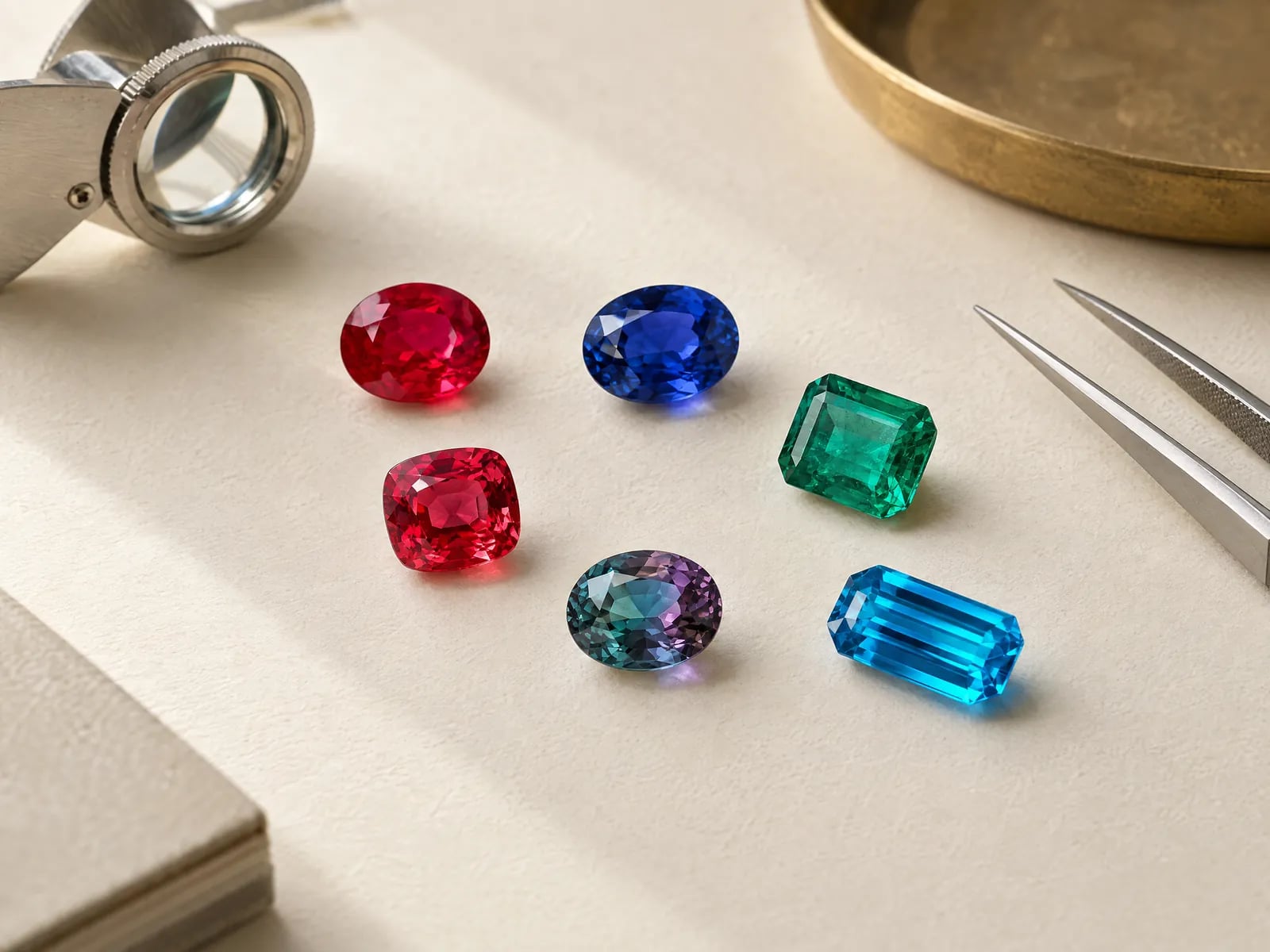
The eight stones
What each stone is, and what sets its price
There is no price list for colored stones, as there is for gold: color, treatment, origin, size and the lab report decide where a stone sits in its range.
Ruby
Red corundum, colored by chromium: the same mineral as sapphire. The finest are a pure, glowing red. Most rubies are heated to improve color and clarity, which the trade accepts.
- Price
- Color first; then treatment (unheated sells at a premium, glass-filled is worth a fraction), origin (Burma, Mozambique, the Thai–Cambodian border) and size.
- Rarity
- Fine rubies above two or three carats are rare; unheated ones rarer still.
Sapphire
Corundum in every color except red. Blue is the classic; pink, yellow, purple, padparadscha and color-change sapphires each have a market of their own.
- Price
- Saturation and tone of the color, heating (routine) versus diffusion (value falls sharply), origin (Kashmir, Burma, Sri Lanka, Madagascar) and size.
- Rarity
- Fine blue sapphire is found in larger sizes than fine ruby; unheated stones above five carats, and padparadscha at any size, are rare.
Spinel
A mineral of its own, mistaken for ruby for centuries. Red, hot pink, cobalt blue, purple and gray, and most of it sold untreated.
- Price
- Color (red, hot pink and cobalt blue lead), no heating, origin (Burma, Tanzania, Vietnam, Sri Lanka) and size.
- Rarity
- Fine red and pink spinel above a few carats is scarce; cobalt-blue spinel is rare at any size.
Emerald
Green beryl, colored by chromium and vanadium. Inclusions are normal, and nearly every emerald is filled with oil or resin to make fractures less visible.
- Price
- Color and transparency, how much clarity enhancement the report finds (none, minor, moderate, significant), origin (Colombia, Zambia, Brazil, Afghanistan) and size.
- Rarity
- Emeralds with no enhancement are rare, and fine ones above a few carats rarer still.
Paraíba tourmaline
Tourmaline colored by copper, found in Brazil's Paraíba state in the late 1980s and later in Nigeria and Mozambique. Its neon blue to green has no close rival.
- Price
- Saturation of the color, copper confirmed by a lab, origin (Brazil carries the premium), clarity and size.
- Rarity
- Fine stones above one carat are scarce, especially from Brazil.
Alexandrite
A variety of chrysoberyl that changes color: green or bluish green in daylight, red or purplish red under incandescent light.
- Price
- The strength and cleanness of the color change, natural rather than lab-grown, origin (Russia, Brazil, Sri Lanka, East Africa) and size.
- Rarity
- Fine alexandrite above one carat is rare. Lab-grown alexandrite is common, so a report is essential.
Tsavorite
Green grossular garnet from East Africa, from Kenya and Tanzania, found in the late 1960s. Bright, lively and usually untreated.
- Price
- A saturated, pure green, clarity and size. Untreated is the norm, so treatment rarely enters the price.
- Rarity
- Clean tsavorite above two or three carats is rare.
Opal
Hydrated silica. Precious opal shows play-of-color, flashes of spectral color that move as the stone turns. The main types are black, boulder, white, crystal and fire opal.
- Price
- Type and body tone (black opal leads), the brightness and pattern of the play-of-color, origin (Australia, Ethiopia, Mexico), stability, and whether it is solid or a doublet or triplet.
- Rarity
- Bright black opal with a broad, vivid pattern is the rarest.