Everystone

For Jewelry Stores

Put your storefront on the trust layer.

Sell the stones in your case to buyers worldwide, with safe settlement on every sale, and be the counter where buyers collect the stones they bought. Under $10,000, no commission and no plan fee while we launch.

Step by step — the Academy guides for jewelry stores →

  • Safe settlement on every sale

    The buyer pays first. You are paid when they confirm.

  • No commission under $10,000

    And no plan fee, while we launch. The buyer pays our fee.

  • Buyers come to your counter

    Be the place where buyers collect stones from the shop.

Two sides of the counter

Sell, hand over and buy, all at your store

Three ways your store works with Everystone. Each one comes with safe settlement.

  1. Sell your own stock

    1. The stones in your case
    2. At your storeYou list them from your cabinet, at your price
    3. A buyer anywhere makes a protected payment

    Only stones your store owns: the platform checks this. Under $10,000, no commission while we launch.

  2. Be the hand-over point

    1. Any stone a buyer chose to collect at your store
    2. At your storeIt arrives insured and sealed; you check the buyer's ID and hand it over
    3. The buyer's check starts, and your store is paid a $30 handover fee

    Switch it on in your cabinet once your business is verified. The buyer has already paid, and passed an identity check.

  3. Buy for your customers

    1. Dealers' stones on the shop
    2. At your storeYou make a protected payment, like any buyer
    3. The stone comes to your store, for your customer

    Your business check (KYB) covers you: no second check before you buy.

How a sale works

Seven steps from your case to your payout

Each step shows who acts and who pays. From step 4, the buyer's money is held until they confirm.

A sale in seven steps: you list the stone; we check it if you want; a buyer pays for it; you confirm the stone within 48 hours; it is shipped, or collected at your counter, as the buyer chooses; the buyer checks it within 48 hours; and you are paid.

  1. 01 · You

    You list the stone

    A phone photo, the report number if you have one, and your price. It goes on the open shop at once, marked Seller-declared: your business check (KYB) stands behind it.

    You pay: nothing. Listing is free, and so is the plan while we launch.

  2. 02 · Everystone · optional

    We check it, if you want

    Send the lab report and we check it with the lab. A hands-on check against the report gives the stone a passport. The lot stays on sale meanwhile.

    Seller-declaredPartly verifiedFull verification

    You pay: nothing for the report check. A passport is optional: $750, once per stone, ordered by you to sell faster or by the buyer.

  3. 03 · Buyer

    A buyer pays for it

    Buyers from any country find it in the shop and pay at checkout. Every buyer passes an identity check (KYC), or a business check (KYB); a short one runs alongside the payment.

  4. 04 · Buyer

    The money is held, and you confirm the stone

    No one is paid until the buyer accepts the stone, and you send nothing until the money is in. You get a letter and confirm in your cabinet within 48 hours that the stone is there, as listed; if it can't be confirmed, the buyer's money goes back in full.

    Buyer pays: your price, plus a 3–7% buyer's premium and a settlement fee of 3%.

  5. 05 · You

    The stone reaches the buyer

    As the buyer chooses: you ship it in a sealed, tracked package and enter the tracking and seal numbers in your cabinet, or it is collected at your counter, by appointment. You send or hand it over once the buyer's identity check is done.

    You choose: insured delivery included in your price, or charged to the buyer (from $60) and shown before they pay.

  6. 06 · Buyer

    The buyer confirms

    Once the buyer has the stone, they have 48 hours to check it and confirm. To dispute it, they need a written conclusion from a gem lab or a jewelry store of their choice. Then they send the stone back, insured, at your cost, and you check that it is the stone you sent. The money stays held meanwhile.

  7. 07 · Everystone

    You are paid

    Once the buyer accepts the stone — they confirm it, or 48 hours pass without a dispute — our desk pays you, with a receipt for the deal.

    You receive: your full price under $10,000. From $10,000, your price less 5%.

Three tiers

The price decides the tier

Every stone starts with a free record. As the price goes up, the check gets deeper and the stone reaches the buyer in a different way.

  1. T0RegistryUnder $10k

    A free digital record

    The check
    Paper cross-checkedSeller-declared until the report is checked.
    To the buyer
    You ship it, sealed and tracked.
    You pay
    No commission and no plan fee while we launch.
  2. T1Passport$10–⁠30k

    A passport, if ordered

    The check
    Verified: paper = this stone
    To the buyer
    Shipped insured, or collected in person — the buyer chooses.
    You pay
    5% when it sells; a $750 passport is optional.
  3. T2Custody$30k and up

    Custody in a vault

    The check
    In custody — passport reflects title
    To the buyer
    Nothing moves: the stone stays in the vault and the title changes hands.
    You pay
    5% when it sells. Custody for your own stock: terms agreed one by one for now.

The money

Two sales, worked out to the dollar

Worked out from our current fees. The buyer's premium and the settlement fee are added on top of your price: you never pay them.

A $4,000 stone

T0Registry

The buyer pays

Your price
$4,000
Buyer's premium (5%)
$200
Settlement fee (3%)
$120
Total
$4,320

You receive

Your price
$4,000
CommissionNone under $10,000 while we launch.
$0
You receive
$4,000
Where the buyer's $4,320 goes
  • To you$4,000
  • Our fee, paid by the buyer on top$320

A $15,000 stone

T1Passport

The buyer pays

Your price
$15,000
Buyer's premium (3%)
$450
Settlement fee (3%)
$450
Total
$15,900

You receive

Your price
$15,000
Commission (5%)
−$750
You receive
$14,250
Where the buyer's $15,900 goes
  • To you$14,250
  • Our commission, from your price$750
  • Our fee, paid by the buyer on top$900

A passport is optional at any price: $750, once per stone, not per sale — ordered by you to sell faster, or by the buyer.

Your cabinet

Your store and its sales, on your phone

Screens from our demo cabinet, with demo stones. Yours shows your own.

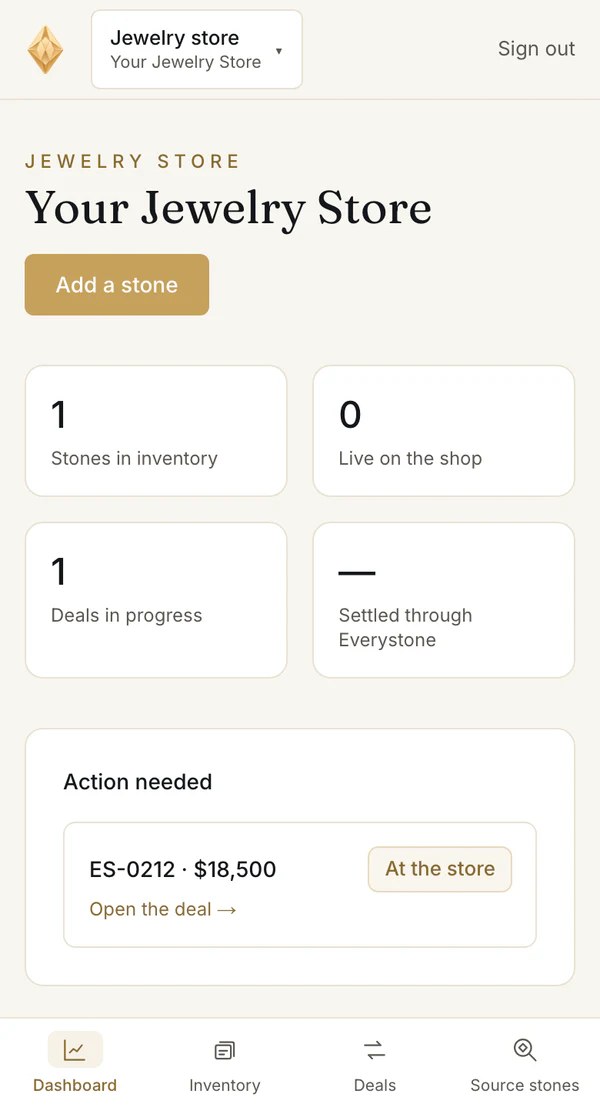
  • The jewelry store cabinet on a phone: 1 stone in inventory, 1 deal in progress, and an action-needed card for an $18,500 sale waiting at the store.
    Your store at a glanceYour stock, your lots on the shop, and the buyer who is coming to collect.
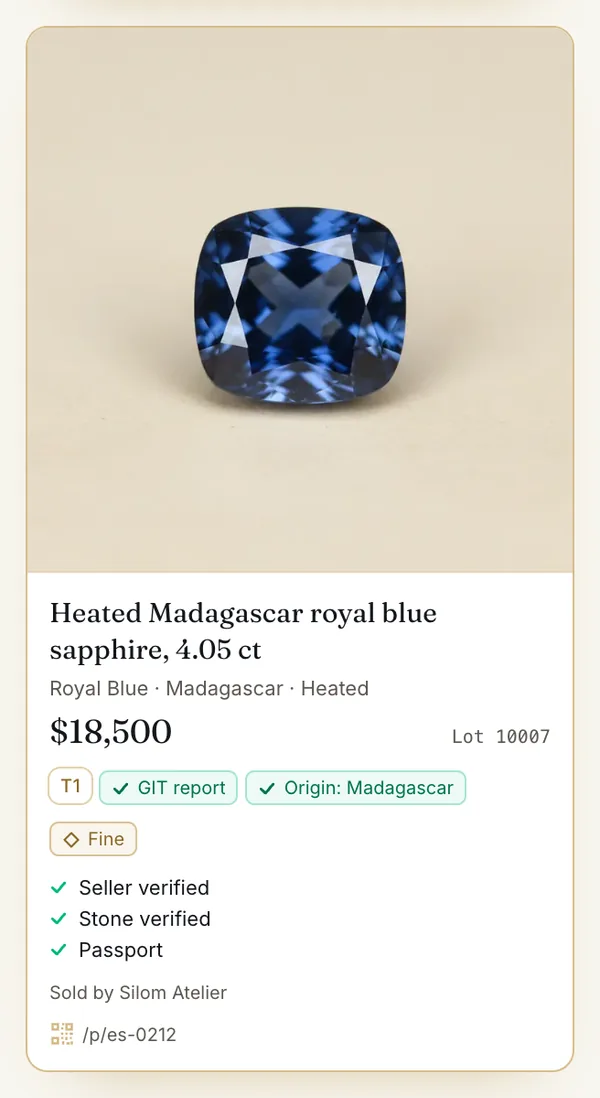
  • A lot card in the shop: a 4.05 ct heated Madagascar royal blue sapphire at $18,500, tier T1, with seals for its GIT report and its Madagascar origin, both checked, and a Fine grade; under them, seller verified, stone verified and Passport, each ticked.
    Your lot, as buyers see itEvery lot shows its tier and how far it has been checked.
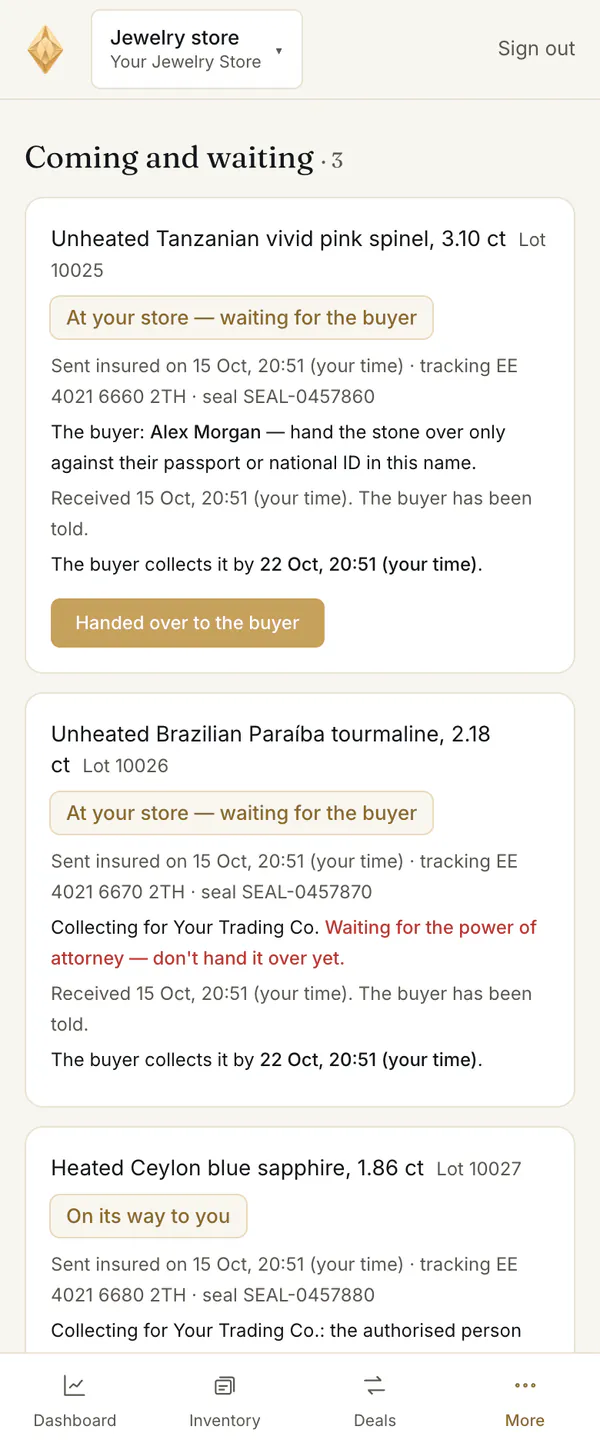
  • The Handovers page of the jewelry store cabinet on a phone. A 3.10 ct spinel waits at the store for its buyer: the buyer's name to check against their ID, the date to collect it by, and a Handed over to the buyer button. Below, a business's stone waits for its power of attorney, and another is on its way to the store.
    A hand-over at your counterEvery stone coming to your store, the name to check the buyer's ID against, and the date they collect it by.

Getting started

Four steps, and your cabinet opens at the first

  1. Step 1: Company details

    Business name, registration number, director and country. It takes a few minutes.

  2. Step 2: Two documents

    Your company registration and the director's ID, as a photo or a PDF.

    Reviewed in about one business day

  3. Step 3: Load your stock

    While we review, your cabinet is open. Add your stones as drafts.

    Only publishing waits

  4. Step 4: Go live

    Once approved, publish your drafts. Send a lab report with a lot and we add the check while it sells.

You stay in control

Your stones, your price, your clients

  • You set the price

    What you ask is what the buyer sees. Under $10,000 it is also what you receive, while we launch.

  • Your clients stay yours

    A buyer you bring yourself is your business. Everystone holds no stock and buys nothing, so we never sell against you.

  • Your name, only on your lots

    Your store's name shows on the lots you publish, with your business check. Nothing is listed in your name without you.

  • Remove a stone any time

    Withdraw a lot from your cabinet and it leaves the shop at once. A stone a buyer has paid for stays in its deal until it closes.

  • One business check

    Two documents (KYB), sent again every two years. Then you list, sell and buy with no second check.

The Academy

Step by step, on the real screens

Short guides to every step, each with screenshots of what you will see.

All 6 guides for jewelry stores

What jewelry stores ask us

What does it cost my store?

While we launch, a stone under $10,000 costs your store nothing: no commission, no plan fee and no listing fee. The buyer pays our fee: a 3–7% buyer's premium and a settlement fee of 3%. From $10,000: 5% of the price when the stone sells. A passport is optional at any price: $750, once per stone.

How does a hand-over at my counter work?

Once your business is verified, switch on "I accept handovers for buyers" in your cabinet, with your address and opening hours. A buyer of any stone that ships can then choose to collect it at your store, and pays a handover fee of $30 with the stone. It is sent to you insured and sealed; you mark it received, check the buyer's passport or ID against the name in your cabinet when they come, and mark it handed over. That starts the buyer's check, and the fee is paid to your store. A stone waits for its buyer at most 7 calendar days, and a business buyer sends the person it authorised, whose name your cabinet shows once our desk has checked the notarised power of attorney.

Can I list stones my store does not own?

No. A jewelry store lists only the stones its own business holds, and the platform refuses anything else. That rule is part of what your check means to a buyer.

Who are the buyers?

Private buyers and trade buyers from any country, who find your stones in our open shop. Every buyer passes an identity check (KYC), or a business check (KYB) if they buy for a company; a short one runs alongside the payment.

What if the buyer disputes?

A buyer can open a dispute only before they confirm, within 48 hours of receiving the stone (longer if support extends it), and only with a written conclusion from a gem lab or a jewelry store of their choice that the stone doesn't match its listing. Our desk then tells the buyer how to send the stone back, and they have 48 hours to send it, insured, at your cost; if they don't, the dispute is withdrawn and you are paid. When the stone is back, you check that it is the stone you sent. If it is, the buyer's money goes back to them and the stone stays with you. If you prove it is not, you are paid and keep the stone that came back. Until then the money stays held, so neither side has it.

What do I need for the business check (KYB)?

Your company registration and the director's ID, as a photo or a PDF. You also give the business name, the registration number, the director and the country. Our desk reviews them in about one business day. Meanwhile your cabinet is open, and you can add stones as drafts. Every two years you send both documents again; your lots stay on the shop while the desk reviews them.

Can I stop at any time?

Yes. Withdraw any lot from your cabinet and it leaves the shop at once. A stone that a buyer has already paid for stays in its deal until the deal closes. To close your account, write to us.


Put the stones in your case in front of buyers

Create an account, add your company and list your stock. Under $10,000, a sale costs your store nothing while we launch: the buyer pays our fee.