How to check a Gübelin report
Verify a Gübelin report with its document number and code, tell a report from a Gem Passport, read the emerald wording, and know what a report can't prove.
 Illustration
To check a Gübelin report, use Gübelin Gem Lab's Lab Document Verification. Documents issued after 2018 need the document number and the verification code printed on the back; older ones need the number, the date and the weight. As of October 2026, Gübelin's website says the online service is unavailable during a platform change, so if the form does not respond, contact a Gübelin office. Either way, a match confirms the document — not that the stone in your hand is the one Gübelin tested.
First, which Gübelin document do you have?
Gübelin Gem Lab issues more than one kind of document, and they do not say the same things.
- Gemmological Report — the full examination. For most coloured stones it includes the Gübelin Gemstone Rating, and it carries the Gübelin Gem Lab Seal.
- Gem Passport — a smaller A5 document for rubies, blue sapphires and emeralds up to 3.0 ct. It is based on a fully automated evaluation of analytical data by Gübelin's Gemtelligence software, with only a brief plausibility check by a gemmologist, and it carries a "Powered by Gemtelligence" sticker. It has no signatures and no Gem Lab Seal.
 Illustration
The difference matters most for treatments. A Gem Passport uses a present-or-absent logic: a ruby or sapphire is heated or unheated; an emerald shows indications of clarity enhancement or it does not, with no extent given. More serious treatments — diffusion with beryllium or other elements, lead-glass filling, irradiation, coatings — appear only under the general term "severe treatment". Cavity fillings in emeralds, and oil or resin in rubies and sapphires, are not disclosed. Gübelin also notes that, in rare cases, a Gem Passport and a full report on the same stone can differ, particularly on origin and treatment.
One naming note: Gübelin's Gem Passport is a laboratory document. It is unrelated to an Everystone Passport.
How to verify a Gübelin document
- 1.Find the verification code. Gübelin says every document issued after 2018 carries one on the back.
- 2.Open the verification form at services.gubelingemlab.com, reached from Gübelin's own website. Type the address yourself rather than following a link from the seller.
- 3.Enter the details. With a code: document number and verification code. Without a code (documents issued before 2019): document number, date and weight.
- 4.Compare what comes back with the paper and with the stone.
Know the limits Gübelin sets out. The database only holds documents less than ten years old. And Gübelin says the online data is for information only, non-binding, and possibly incomplete or inaccurate: "The only valid document is the unaltered original document from the Gübelin Gem Lab."
As of October 2026, Gübelin's redesigned website states that online verification is currently unavailable because of a change of website platform, and asks owners to contact one of its offices instead. Gübelin lists locations including Lucerne, Hong Kong, New York and Bangkok. If the form fails, that is the route.
Signs of an altered or fake Gübelin document
- No verification code on a document dated after 2018.
- Data that does not match the online record, or a weight that does not fit the stone.
- A Gem Passport presented as a full report, or used to claim things it does not state — an extent of clarity enhancement, an emerald's cavity filling, a specific treatment method.
- A document older than ten years offered as "verifiable online". It will not be in the database; confirm it with the lab.
- A link or QR code that opens anything other than a Gübelin domain.
What a Gübelin report proves — and what it doesn't
| A genuine Gübelin document proves | It does not prove |
|---|---|
| Gübelin examined a stone and recorded these findings on that date | That the stone in your hand is that stone |
| The identification, treatment status and origin opinion Gübelin gave | That nothing has been added, removed or re-cut since |
| That the paper is Gübelin's, once confirmed with the lab | A value or price |
Gübelin offers its own answer to the first gap: a Free Integrity Test, which checks whether a gemstone matches the data in its Gübelin report and so whether it has been altered or substituted since the document was issued. For a significant purchase backed by a Gübelin report, it is worth asking for.
Gübelin emerald reports: reading the clarity line
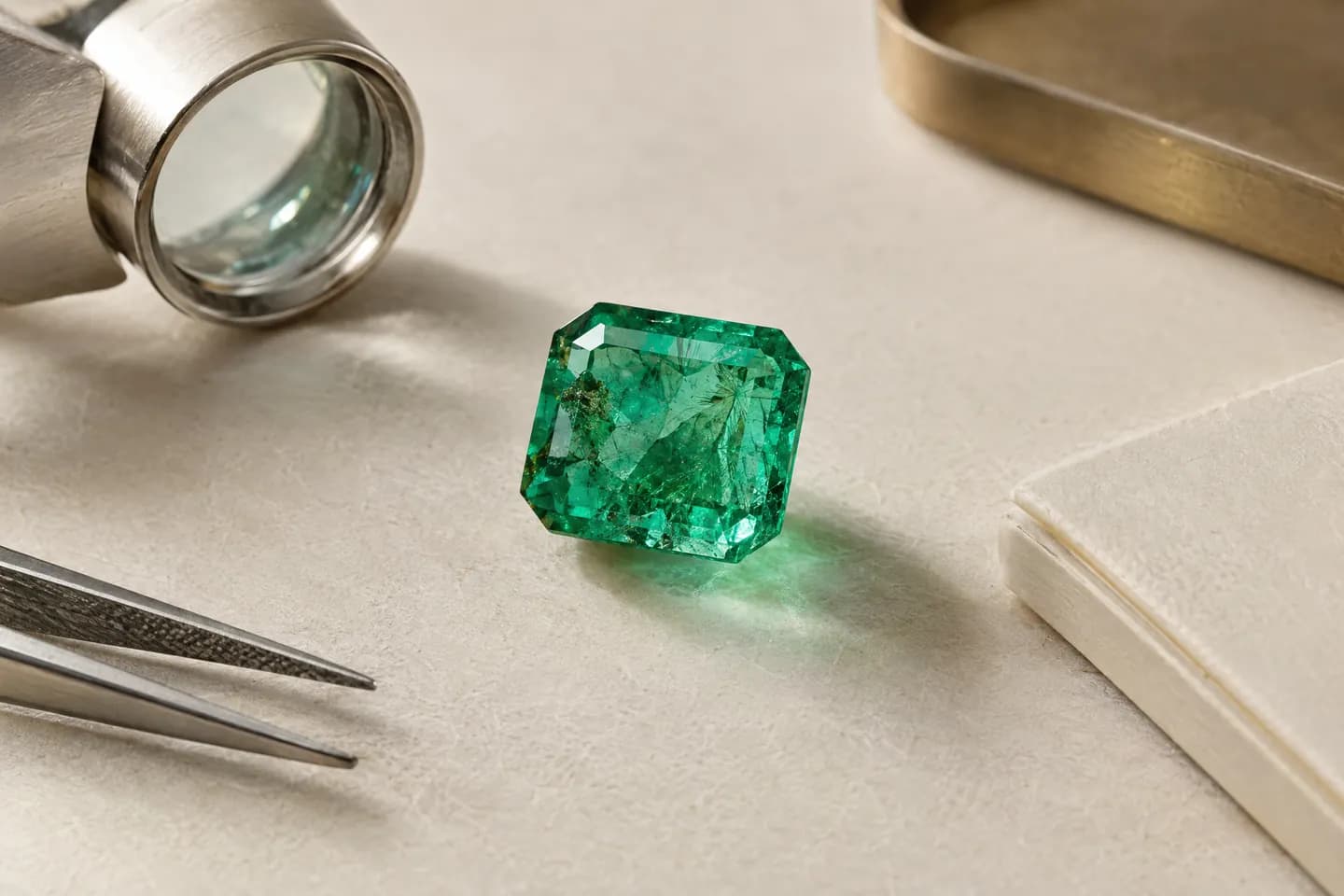
Gübelin is a member of the Laboratory Manual Harmonisation Committee (LMHC), whose shared wording for emeralds runs from no indications of clarity enhancement through minor (F1), moderate (F2) and significant (F3).
 Illustration
On 1 November 2025 Gübelin dropped its old "insignificant" category to align with the other LMHC labs. Emeralds that would previously have been described as showing indications of insignificant clarity enhancement are now reported as showing no indications of clarity enhancement. So an older Gübelin report that says "insignificant" and a newer one that says "no indications" may describe the same condition. Compare like with like.
Two cautions apply to any emerald report. First, the shared LMHC wording notes that clarity enhancement is usually reversible and repeatable at any time, and that a report states the condition only at the time of examination. Second, filler type is a separate question: on a Gem Passport it is not assessed by default, and the extent of filling requires a full Gemmological Report.
For the wider case against trusting a scan, see cross-checking a lab report.
What Everystone does about it
A free Registry record keeps a stone's details and its Gübelin document number in one place you can share, and once the document number is confirmed with Gübelin, the record says so. Matching that document to the physical stone is what an Everystone Passport adds: the report describes a stone, the passport shows it is this one. When you buy through the shop, every lot says how far it has been checked, from seller-declared to full verification, and your payment is held until you confirm the stone. More on buying safely.
Questions
How do I verify a Gübelin report?
Use Gübelin Gem Lab's Lab Document Verification form. For documents issued after 2018, enter the document number and the verification code printed on the back; for older ones, the document number, date and weight. The database covers documents less than ten years old, and if the online service is unavailable, contact a Gübelin office directly.
What does a Gübelin emerald report say about oil?
A Gübelin Gemmological Report states whether there are indications of clarity enhancement and, if so, its extent, using the minor, moderate and significant scale shared by the LMHC labs. Since 1 November 2025 Gübelin no longer uses the category 'insignificant'; stones that would have received it are now reported as showing no indications of clarity enhancement. The finding describes the stone at the time of testing only.
What is the difference between a Gübelin Gem Passport and a Gemmological Report?
A Gem Passport is a smaller document for rubies, blue sapphires and emeralds up to 3.0 ct, based on an automated evaluation of analytical data with only a brief check by a gemmologist. It discloses treatment as simply present or absent, gives no extent of clarity enhancement, and carries no signatures or Gem Lab Seal. A Gemmological Report is the full examination.
Why is 'insignificant' missing from new Gübelin emerald reports?
Gübelin dropped the category on 1 November 2025 to align its wording with the other labs of the Laboratory Manual Harmonisation Committee. An older Gübelin report reading 'insignificant' and a newer one reading 'no indications of clarity enhancement' may describe the same condition.
Can Gübelin confirm my stone is the one in the report?
Yes. Gübelin offers a Free Integrity Test that checks whether a gemstone matches the data recorded in its Gübelin report, and so whether it has been altered or substituted since the document was issued. Contact the lab to arrange it.