
How much is my ruby worth?
How much is your ruby worth? What sets the price, how an appraisal differs from a lab report, and what a buyer would actually pay you.
 Illustration
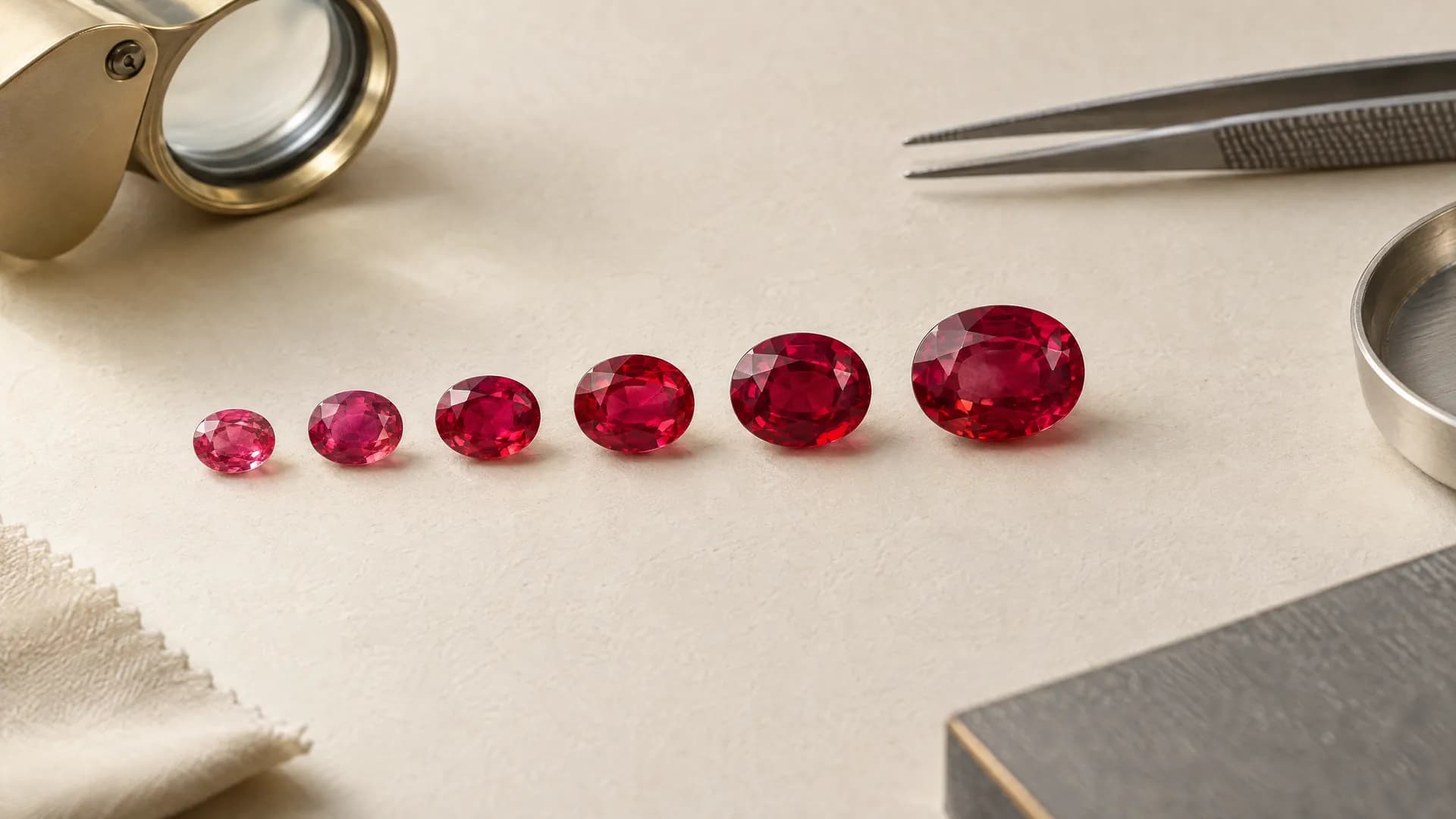
A ruby can be worth almost nothing or more than a million dollars per carat, and two stones of the same weight can be ten times or more apart in price. Where yours falls depends on what it is — natural or lab-grown, treated or not — and on its color, clarity, cut, size and origin. None of that can be judged reliably by eye or from a photo. A defensible figure starts with an independent lab report and ends with a valuation made for a stated purpose.
What sets the price of a ruby
Dealers look at the same handful of things. Identity and treatment come first, because they decide what kind of stone you have; after that, color matters more than anything else.
Natural, lab-grown or something else
Ruby was the first gem grown in a laboratory. The flame-fusion method was announced in 1902, and GIA notes it is still the least expensive way to make synthetic corundum. A lab-grown ruby has the same chemistry as a natural one, sells for a fraction of the price and has little resale value. Red spinel, garnet and glass have all been passed off as ruby as well. Only a lab can settle what you have.
Treatment
Most rubies on the market have been heated, and the trade generally accepts it. A fine ruby with no evidence of heating carries a premium, because it is rarer. Two other treatments change the picture: color diffused into the surface, and fractures filled with lead glass. GIA's buyer's guide says rubies treated these ways are worth less than heated rubies, and its journal described heavily glass-filled material as trading at "extremely low prices". Some of that material would fall apart without the glass.
Color
The finest rubies are a pure, vivid red to slightly purplish red — not so dark that the stone looks closed, not so light that it reads as pink sapphire. Orange or purple overtones lower the price. "Pigeon's blood" is a trade name for the top of the range; several labs use it on reports, their criteria are not identical, and the term moves prices.
Clarity and cut
Almost every ruby has inclusions, and buyers expect them. What costs money are inclusions you can see, especially under the large top facet, and anything that dulls the stone. A good cut spreads the color evenly; a shallow one leaves a washed-out "window" in the middle. Cutters trade weight against looks, and a stone cut to save carats shows it.
Size
Fine rubies over one carat are rare, and the price per carat rises significantly with size. A three-carat stone is not worth three one-carat stones. It is usually worth considerably more.
Origin
Myanmar (Burma) has the longest reputation, and a Burmese origin on a respected lab's report adds a premium to a fine stone. Mozambique, where a major deposit was found near Montepuez in 2009, has since become one of the most productive sources of gem ruby. Origin on a report is an opinion built from inclusions and trace-element chemistry; when the evidence is not clear, the lab calls it inconclusive. A famous mine also produces poor stones.
The report, and which lab issued it
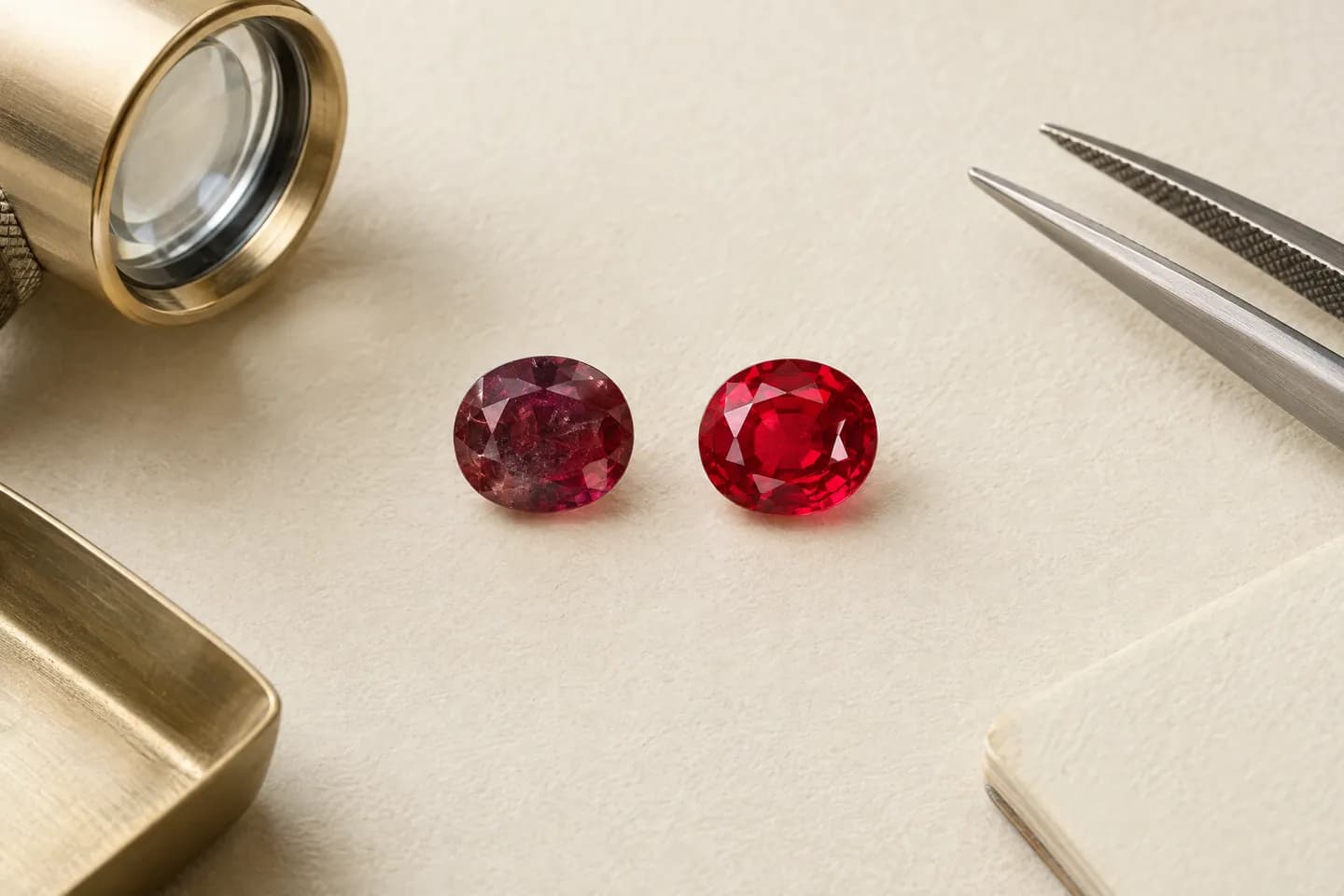
For a ruby of real value, buyers want a report from an independent lab they recognize — GIA, SSEF, Gübelin, GRS, AGL and a few others — stating whether it is natural, what treatment was detected and, if requested, an origin opinion. Next to the stakes, reports are inexpensive: GIA's published fee for identifying a ruby under two carats is $75, or $90 with an origin opinion (fee schedule effective October 1, 2026). Check any report's number against the lab's own records before relying on it; here is how.
Why two one-carat rubies can be ten times or more apart
| Ruby A | Ruby B | |
|---|---|---|
| Weight | 1.02 ct | 1.05 ct |
| Identity | natural ruby | natural ruby |
| Color | vivid, slightly purplish red | dark, brownish red |
| Clarity | clean to the eye | fractures visible face-up |
| Treatment | no evidence of heating | fractures filled with lead glass |
| Paper | international lab report with origin opinion | none |
 Illustration
Both can be sold as "a natural one-carat ruby". One is rare at any size. The other belongs to a category GIA says is worth less than heated ruby. The difference between them is not a percentage — it can be a factor of ten or more.
Retail price, appraisal, and what a buyer pays
Several different numbers get attached to the same stone. They are not interchangeable.
| Number | Who produces it | What it means |
|---|---|---|
| Retail price | a shop | the price tag, including the shop's costs and margin |
| Insurance appraisal | an appraiser | what replacing the piece at retail would cost |
| Fair market value | an appraiser | what a willing, informed buyer would pay a willing, informed seller |
| An offer | a dealer, auction house or private buyer | what you can actually get, after the buyer's margin, risk or fees |
The insurance figure is usually the highest, and a dealer's offer usually the lowest. That is not necessarily unfair: a dealer has to resell the stone, wait for a buyer and carry the risk. You get closer to fair market value by removing the buyer's doubt and by choosing a route that takes less off the top — see how selling works.
How to get a number you can defend
- 1.Have the stone identified by an independent lab: natural or not, any treatment, and an origin opinion if the stone looks fine enough to justify one.
- 2.Check the report number on the lab's website.
- 3.Ask an independent appraiser — not someone bidding for the stone — for a valuation with a stated purpose: insurance, or fair market value. Agree a flat or hourly fee, never a percentage of the value.
- 4.Look for comparables: auction results for rubies of similar weight, color, treatment, origin and lab. The major auction houses publish past results.
- 5.If you are selling, get more than one written offer and compare what you would receive after every fee, not the headline price.
 Illustration
What the very top looks like
Two auction results mark the ceiling. The Sunrise Ruby — 25.59 carats, unheated, from Burma — sold at Sotheby's Geneva on 12 May 2015 for $30.3 million, about $1.18 million per carat. The Estrela de Fura — 55.22 carats, from Mozambique — sold at Sotheby's New York on 8 June 2023 for $34.8 million, about $630,000 per carat. These are not comparables for an ordinary stone. Price history is history, not a forecast, and nothing here is investment advice.
What Everystone does about it
Everystone doesn't appraise stones and won't quote a price for one it hasn't seen. What it does is make a ruby's facts checkable, because a fair price rests on them. The report describes a stone; a passport records a hands-on check that it is this one.
- A free Registry record holds your ruby's report details. Once the report number is confirmed with the issuing lab, the record is labeled "paper cross-checked" — a paper check, because nobody has examined the stone.
- For stones worth $10,000–30,000, a Tier 1 passport adds a hands-on check that the report describes this exact stone — $750, once.
- If you sell through Everystone, the lot states exactly how far it has been checked and the buyer makes a protected payment. Registering the ruby is free; to sell it, you list it from your cabinet and pay a one-time $20 listing fee for the lot, and the lot goes live once the desk confirms the payment and reviews it. While we launch you pay no seller commission under $10,000, because the buyer pays our fee; from $10,000 you pay 5% when the sale completes. Every fee is on the pricing page.
Questions
How much is a pigeon's blood ruby worth?
There is no list price. Pigeon's blood is a trade name for the most saturated, pure red, and several labs print it on reports, though their criteria are not identical. The term can lift a price considerably, but size, treatment, origin and the lab that used it still decide the figure. Record-setting stones in this color are not comparables for a typical ruby.
Is a Burmese ruby always worth more?
Not automatically. A Myanmar origin on a respected lab's report adds a premium to a fine ruby, but every mine also produces poor material, and GIA points out that a famous source is no guarantee of quality. Origin is also an opinion: when the evidence is unclear, the lab reports it as inconclusive.
Are lab-grown rubies worth anything?
Very little on resale. They are real ruby in chemistry, but they are made to order: flame fusion, announced in 1902, is still the cheapest way to grow corundum. In the US a seller must disclose that a stone is laboratory-grown, and a lab report will say so.
How much is my ruby ring worth?
Value the stone first, then the metal, any diamonds and the maker if the ring is signed. A shop's price or an insurance appraisal for the ring will sit well above what a buyer would pay you, and that gap is normal. A fair-market-value appraisal is the closest independent estimate of a sale price.
Sources
- GIA — Ruby Buyer's Guide
- GIA, Gems & Gemology — Geographic Origin Determination of Ruby (Winter 2019)
- GIA, Gems & Gemology — An Era of Sweeping Change in Diamond and Colored Stone Production and Markets (Fall 2010)
- The Jewellery Editor — Sotheby's Geneva results: the Sunrise Ruby (May 2015)
- Rapaport — 55ct. Ruby Fetches World-Record $35M (June 2023)


