
How much is my sapphire worth?
How much is your sapphire worth? What sets the price, how an appraisal differs from a lab report, and what a buyer would really pay you.
 Illustration
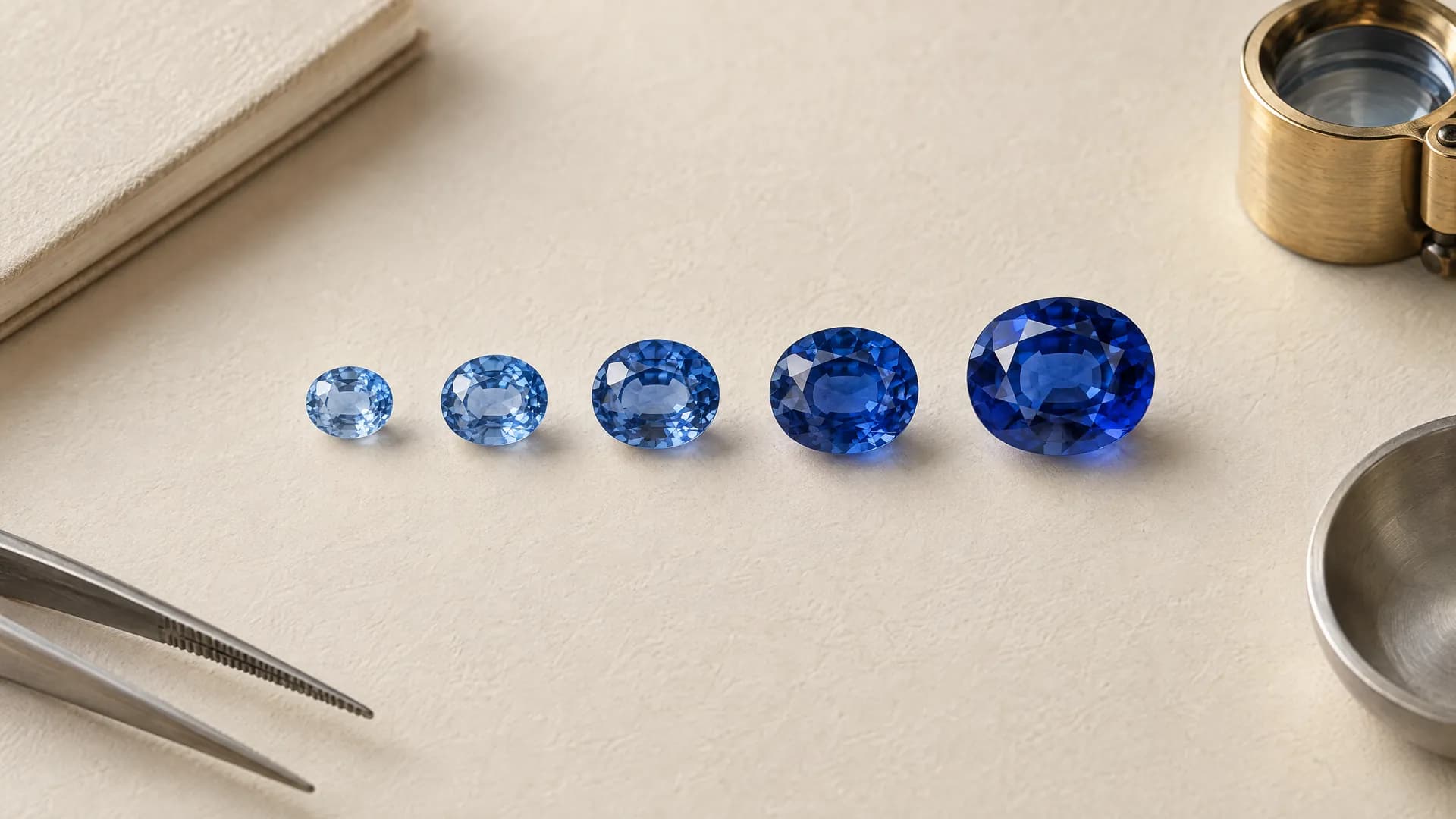
A sapphire can be worth very little or several hundred thousand dollars per carat, and two stones of the same weight can sit ten times or more apart. The price depends first on what the stone is — natural or lab-grown, untreated, heated or diffused — then on color, which outweighs everything else, and on clarity, cut, size and origin. A photo can't give you a defensible number. An independent lab report and a valuation made for a stated purpose can.
The factors behind a sapphire's price
Natural or lab-grown
Sapphire has been grown by flame fusion since the early twentieth century, and GIA describes the method as still the least expensive way to make synthetic corundum. A lab-grown sapphire can look convincing and sells for a small fraction of a natural one. In the US, the FTC requires lab-made gems to be described in a way that leaves no doubt about their origin. A lab report settles the question.
Heated, diffused or untreated
A large share of the sapphire on the market has been heated to improve color or clarity, and heating is an accepted treatment. For a fine stone, GIA notes that a lab's confirmation of no evidence of heat adds to its rarity and value. Lattice diffusion is different: heat and chemicals drive a coloring element into the stone, and GIA says such sapphires generally cost less than heated or untreated ones. Ask what the report says about treatment before you ask anything else.
Color
The most prized blue sapphires are velvety blue to violetish blue, in medium to medium-dark tones, with strong to vivid saturation — as intense as possible without darkening. Stones that are too dark lose brightness and value. Sapphire also comes in pink, yellow, purple, green and the pink-orange called padparadscha, whose definition is still debated; GIA indicates on its reports when a stone meets its criteria. Trade color names such as "royal blue" appear on some labs' reports, each against that lab's own standard.
Clarity and cut
Some inclusions are normal, and extremely clean blue sapphires are rare and priced accordingly. Inclusions that threaten durability cut the value. Kashmir stones are the famous exception: tiny inclusions give them the soft, velvety look buyers pay for. Cut matters more than most owners expect. Sapphire often shows uneven color zones and different hues from different directions, and a cutter who orients it well makes a visibly better stone.
Size
Large sapphires are easier to find than large rubies, but most commercial-quality blue sapphires weigh under five carats, and fine large stones are rare. As with ruby, the price per carat of fine material climbs with size.
Origin
Kashmir earns the highest premium. The deposit was found around 1881 and worked productively only until about 1887, so fine Kashmir stones rarely come to market. Myanmar (Burma), Sri Lanka (Ceylon) and Madagascar also produce top-quality sapphire — and every source produces poor stones too. Origin on a report is an opinion drawn from inclusions, trace elements and spectroscopy, and GIA's researchers note that clean, high-end stones often lack the evidence for a firm call.
The report, and the lab behind it
For a sapphire of real value, buyers expect a report from a lab they recognize — GIA, SSEF, Gübelin, GRS, AGL and a handful of others — covering identity, treatment and, on request, origin. The most valuable stones often carry reports from two labs. GIA's published fee for identifying a sapphire under two carats is $75, or $90 with an origin opinion (fee schedule effective October 1, 2026). Before relying on any report, check its number against the lab's records — here is how.
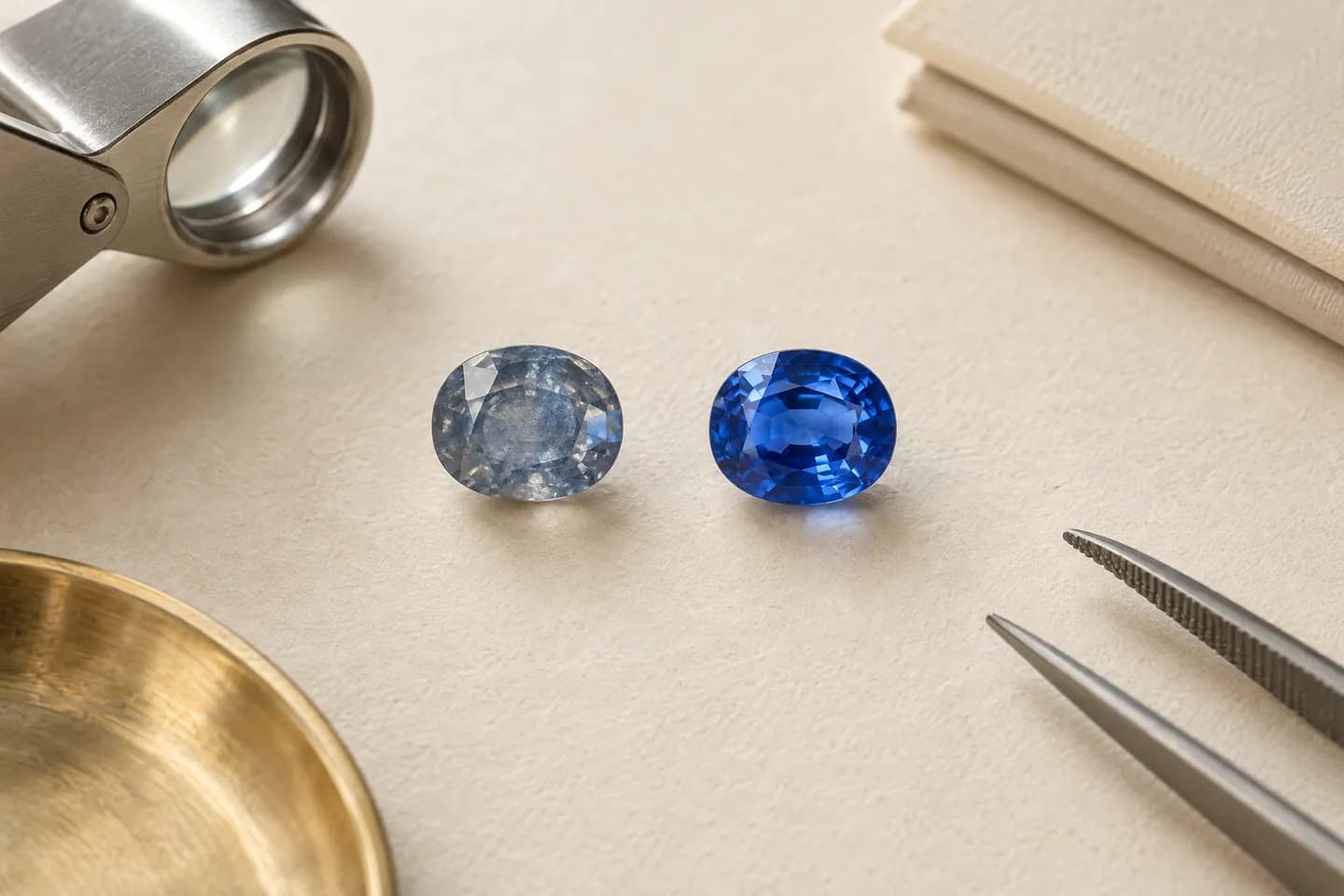
Two one-carat sapphires, ten times or more apart
| Sapphire A | Sapphire B | |
|---|---|---|
| Weight | 1.01 ct | 1.04 ct |
| Identity | natural sapphire | natural sapphire |
| Color | vivid violetish blue, medium-dark | very dark blue, little brightness |
| Clarity | clean to the eye | inclusions visible face-up |
| Treatment | no evidence of heating | lattice diffusion |
| Paper | international lab report with origin opinion | none |
 Illustration
Both are "a natural one-carat blue sapphire". One is rare and documented. The other combines a treatment that GIA ranks below heating with weak color and no paper. The price between them can differ ten times or more.
The numbers people mix up
- Retail price — what a shop asks. It covers the shop's rent, staff and margin.
- Insurance appraisal — the cost of replacing the piece at retail. Your insurer needs it, and it is usually the highest figure you will see.
- Fair market value — the price a willing buyer and a willing seller would agree on, neither forced to act and both reasonably informed. Estates and tax authorities use it, and it usually sits below retail.
- An offer — what someone will actually pay you today. A dealer has to resell, wait and carry risk, so the offer sits below fair market value; other routes charge fees instead.
The distance between an insurance figure and a real offer surprises many owners. It is normal, and documentation is what narrows it: a buyer who doesn't have to guess doesn't have to discount. See how selling works.
Getting to a number you can defend
- Get an independent lab report: identity, treatment, and an origin opinion if the stone justifies one.
- Confirm the report number with the issuing lab.
- Commission an appraisal from someone who isn't trying to buy the stone, for a named purpose and a flat or hourly fee.
- Compare against auction results for sapphires of similar weight, color, treatment, origin and lab.
- If you sell, compare offers on what you would receive after every fee.
 Illustration
The top of the market, for context
On 27 May 2025, The Regent Kashmir — an unheated 35.09-carat Kashmir sapphire — sold at Christie's Hong Kong for about $9.5 million, roughly $270,000 per carat and, as of October 2026, the record per carat for a sapphire at auction. The Blue Belle of Asia, a 392.52-carat Ceylon sapphire, sold at Christie's Geneva in November 2014 for about $17.3 million, roughly $44,000 per carat. The far larger stone fetched a fraction of the Kashmir price per carat: size is one input among several. Neither is a comparable for an everyday sapphire, and past prices are history, not a forecast or investment advice.
What Everystone does about it
Everystone isn't an appraiser and doesn't price stones from photos. Its job is to make a sapphire's facts checkable, so a buyer has less to discount:
- A free Registry record stores the report details. Once the report number is confirmed with the issuing lab, the record is labeled "paper cross-checked" — a paper check, because nobody has examined the stone.
- For stones worth $10,000–30,000, a Tier 1 passport adds a hands-on check that the report describes this exact stone ($750, once).
- When you sell through Everystone, your lot shows how far it has been checked and the buyer's money is held until they confirm. Registering the stone is free; to sell it, you list it from your cabinet and pay the $20/month account, and the lot goes live once the desk confirms the payment and reviews it. While we launch there is no seller commission under $10,000, because the buyer pays our fee; from $10,000 it is 5% of a completed sale. All fees are on the pricing page.
Questions
How much is a Kashmir sapphire worth?
More than a comparable stone from anywhere else — if a respected lab agrees it is from Kashmir. In May 2025 an unheated 35.09-carat Kashmir sapphire sold at auction for roughly $270,000 per carat, but that is the ceiling, not a guide. Smaller or heavily included Kashmir stones sell for far less, and without a lab's origin opinion the name adds nothing.
Is a Ceylon sapphire valuable?
It can be. GIA lists Sri Lanka among the sources of top-quality sapphire. As anywhere, the price depends on color, treatment, clarity and size, and a lab's confirmation that a fine stone shows no evidence of heating adds to its value.
Are lab-created sapphires worth anything?
Not much on resale. They are cheap to grow — flame fusion is the least expensive method — so a lab-created sapphire sells for a small fraction of a natural one. In the US, sellers must make the laboratory origin clear, and a lab report will state it.
What is a padparadscha sapphire worth?
That depends heavily on the report. The name covers a narrow range of pinkish orange to orangy pink, its definition is debated, and labs state on the report whether a stone meets their criteria. A stone a lab calls padparadscha is priced very differently from one it calls an orange-pink sapphire.
How much is my sapphire ring worth?
Price the center stone first, then the metal, any side diamonds and the maker. A shop's price or an insurance appraisal will sit well above what a buyer would pay you; a fair-market-value appraisal is the honest middle figure.
Sources
- GIA — Sapphire Buyer's Guide
- GIA, Gems & Gemology — Geographic Origin Determination of Blue Sapphire (Winter 2019)
- GIA — Historical Reading List: Kashmir Sapphires
- TheValue — The Regent Kashmir sells for US$9.5m at Christie's Hong Kong (May 2025)
- National Jeweler — 'Blue Belle' rings in record sale for Christie's (November 2014)
- IDEX Online — Kashmir sapphire sets per-carat auction record (28 May 2025)
- eCFR — 16 CFR 23.25, FTC Guides for the Jewelry Industry