
Blue sapphire price per carat: what Bangkok catalogues ask, and what moves it
What blue sapphires ask per carat in three Bangkok dealers' public catalogues in October 2026, by treatment, origin and size, and what moves the price.
 Illustration
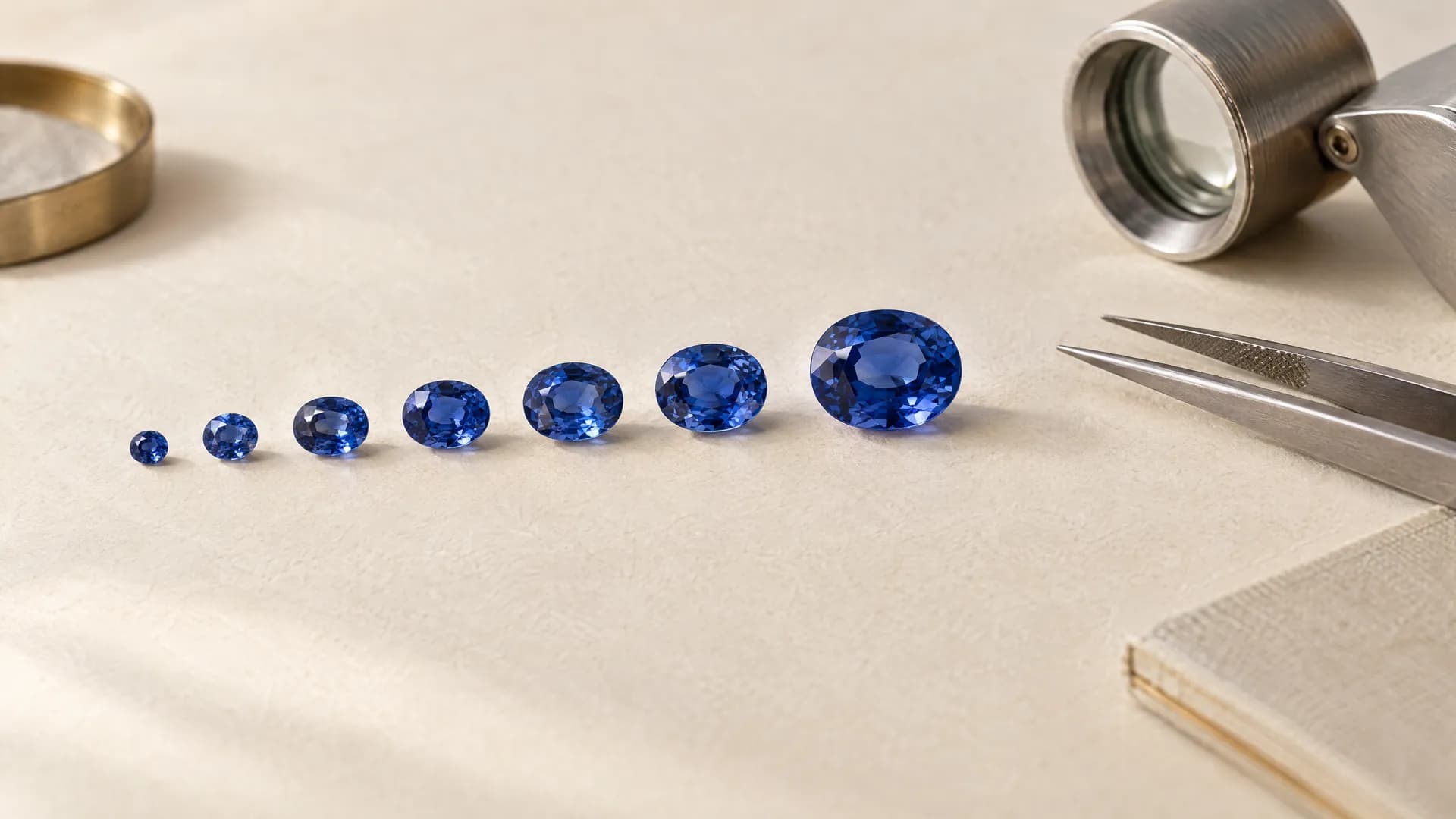
On 1 October 2026, blue sapphires of 1–2 carats in three Bangkok dealers' public catalogues asked a median of $960 per carat (n = 91). Heated stones of that size asked $880 (n = 64) and unheated ones $2,600 (n = 27), though most of those unheated stones were listed with an origin and the heated ones without. Across all sizes, blue sapphires with a declared Sri Lankan origin asked $2,140 per carat (n = 48), while those whose origin was not stated asked $840 (n = 208).
Blue sapphire: asking price per carat by size
| Size | Sapphires (n) | Median $/ct | Middle half $/ct | Lowest–highest $/ct | Dealers |
|---|---|---|---|---|---|
| 1–2 ct | 91 | $960 | $840–1,320 | $540–4,450 | 3 · one >70 % |
| 2–3 ct | 92 | $970 | $600–1,450 | $410–4,450 | 3 · one >70 % |
| 3–5 ct | 77 | $1,080 | $480–2,140 | $240–2,890 | 3 |
| 5–10 ct | 23 | $400 | $230–890 | $130–3,600 | 3 |
The median barely moves between 1 and 5 carats and falls at 5–10 ct. That does not mean size is irrelevant. It means each size band draws on different catalogues and different qualities: 11 of the 23 blue sapphires of 5–10 ct asked under $400 per carat, and 10 of those 11 were listed without an origin. Two blue sapphires of 2–3 ct can be ten times apart: single asks in that band ran from $410 to $4,450 per carat. Our data has no sapphires under 1 ct and too few above 10 ct to show.
By treatment
| Declared treatment | Size | Sapphires (n) | Median $/ct | Middle half $/ct | Lowest–highest $/ct | Dealers |
|---|---|---|---|---|---|---|
| Heated | 1–2 ct | 64 | $880 | $840–1,080 | $540–1,500 | 3 · one >70 % |
| Heated | 2–3 ct | 61 | $1,080 | $760–1,450 | $410–2,520 | 3 |
| Heated | 3–5 ct | 54 | $1,690 | $1,000–2,490 | $270–2,890 | 3 |
| Heated | 5–10 ct | 19 | $400 | $190–890 | $130–3,600 | 3 |
| Unheated | 1–2 ct | 27 | $2,600 | $1,090–3,300 | $550–4,450 | 2 |
| Unheated | 2–3 ct | 31 | $600 | $520–1,320 | $420–4,450 | 3 · one >70 % |
| Unheated | 3–5 ct | 19 | $600 | $360–810 | $300–1,440 | 2 · one >70 % |
Read across the rows with care. At 1–2 ct, unheated blue sapphires asked about three times as much per carat as heated ones, but at least 15 of those 27 unheated stones were listed with an origin and at most one of the 64 heated ones was, so the gap mixes heat with origin and catalogue. At 2–3 and 3–5 ct the unheated medians fall below the heated ones, because 41 of those 50 unheated stones come with no stated origin, mostly from one lower-priced catalogue. This is the limit of any asking-price table: it cannot hold colour and clarity constant, and an unheated label on a dull stone does not make it a fine one.
By declared origin
| Declared origin, blue sapphires | Sapphires (n) | Median $/ct | Middle half $/ct | Lowest–highest $/ct | Dealers |
|---|---|---|---|---|---|
| Sri Lanka, all sizes | 48 | $2,140 | $1,450–2,600 | $240–3,300 | 3 · one >70 % |
| Sri Lanka, 2–3 ct | 15 | $1,730 | $1,450–2,140 | $600–3,300 | 2 · one >70 % |
| Sri Lanka, 3–5 ct | 31 | $2,140 | $1,940–2,600 | $240–2,890 | 3 · one >70 % |
| Not stated, all sizes | 208 | $840 | $540–1,080 | $110–3,120 | 3 · one >70 % |
A missing origin is a signal in itself. Blue sapphires listed with no origin asked well under half the median of those with one, and under half in each size band from 1 to 5 ct. Dealers name the origin when it helps the price; when a listing is silent, treat the origin as unknown and don't pay for one. Blue sapphires declared Madagascan (14) and Burmese (12) are too few to show; across all colours, sapphires declared Madagascan asked $2,140 per carat (n = 22). GIA gives Kashmir the highest premium and names Burma, Sri Lanka and Madagascar among the sources of top-quality stones.
Pink, yellow and other colours
| Colour group | Size | Sapphires (n) | Median $/ct | Middle half $/ct | Lowest–highest $/ct | Dealers |
|---|---|---|---|---|---|---|
| Pink | all sizes | 34 | $720 | $600–1,080 | $300–4,450 | 3 · one >70 % |
| Yellow | all sizes | 36 | $520 | $410–620 | $180–1,540 | one dealer |
| Other colours | all sizes | 33 | $600 | $360–840 | $360–1,560 | 2 · one >70 % |
 Illustration
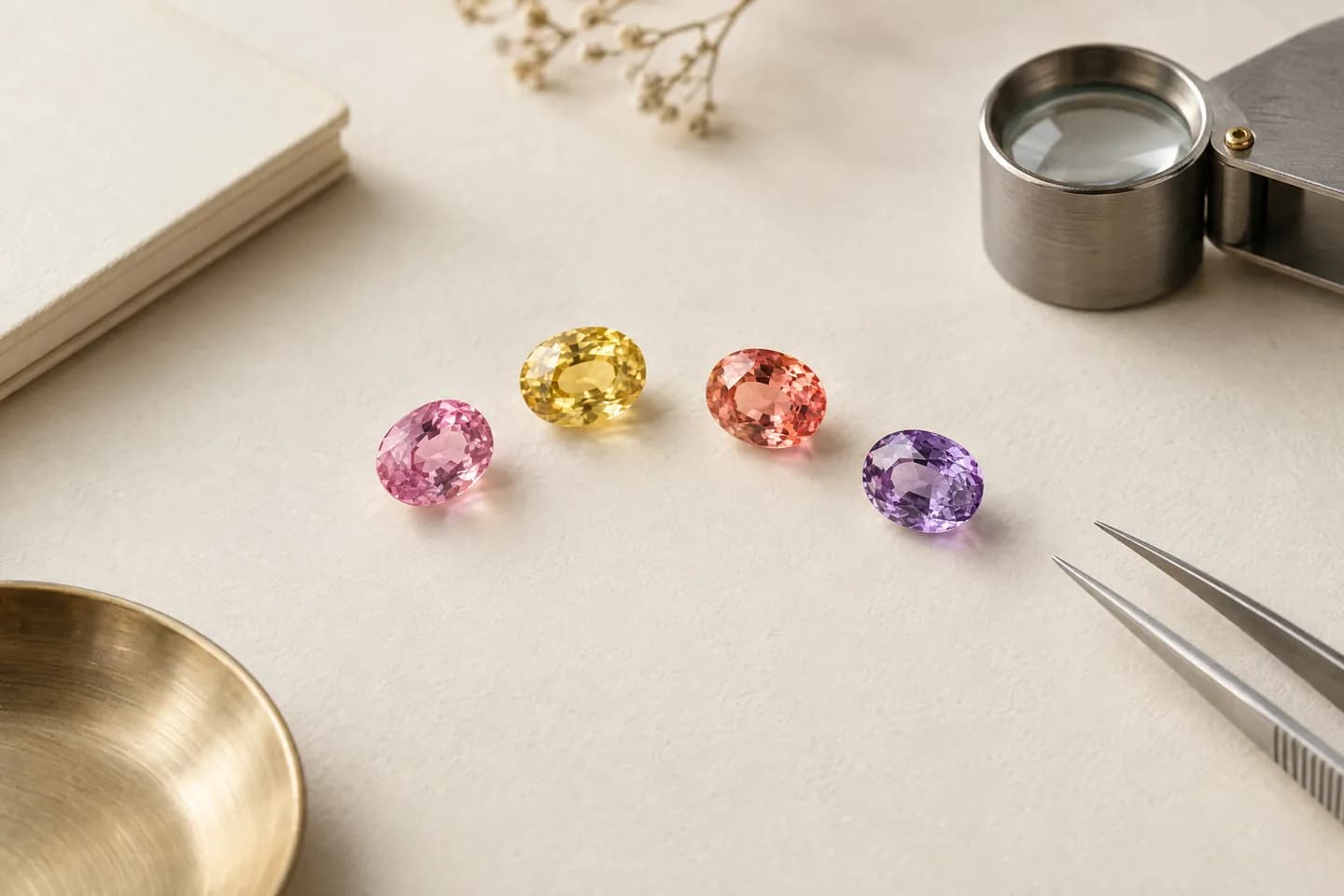
These fancy-colour figures say more about one catalogue than about pink or yellow sapphire in general: most of the stones come from the same lower-priced list, and 23 of the 36 yellow sapphires were declared with beryllium. Colour groups follow the dealer's own words. "Other colours" collects purple, violet, green, teal, orange, white, brown, bi-colour and colour-change stones, and pink-orange stones that the listing did not call padparadscha.
Only one stone was listed as padparadscha. The name has a definition that the labs of the LMHC, a committee of seven labs including GIA, SSEF and Gübelin, share: a pinkish orange to orangey pink of pastel tone that passes a colour-stability test, heated or not, but never beryllium-diffused, glass-filled or irradiated.
Beryllium and other treatments beyond heat
39 sapphires were declared with beryllium: 38 that their dealer lists as heated and probably beryllium-treated, and one outright. They asked a median of $540 per carat (middle half $360–690), just over half the $960 median of the 251 heated sapphires. Lattice diffusion adds an element from outside the stone during heating to change its colour. When a lab finds it, the report says so; when the evidence points that way but is not conclusive, the report says that the heating may involve beryllium, or that further analysis is needed. If a sapphire's price looks low for its colour, ask for a report that addresses beryllium.
 Illustration
The colour names in a listing need the same care. 11 of the 12 sapphires listed as "royal blue" were declared heated. SSEF and Gübelin reserve "royal blue" for untreated stones, while GRS also uses it for heated sapphires, though not for diffusion- or pressure-treated ones; in a catalogue, it is a description, not a grade.
What moves the price of a sapphire
- Colour. GIA prizes "velvety blue to violetish blue, in medium to medium dark tones" with strong to vivid saturation. Very dark, greyish or pale stones cost less.
- Treatment. Heating is accepted and expected; unheated stones of fine colour are rarer. Diffusion-treated stones cost less than heated or untreated ones.
- Origin. It matters most for fine stones, and only when a report states it.
- Size. GIA notes that most commercial blue sapphires are under five carats; fine large stones are scarce.
- Clarity and cut. Blue sapphires of very high clarity are rare and valuable; poorly cut stones sell at a discount.
- The report. 126 of the 392 listings name a lab. In each of the three catalogues, the stones with a named report asked more than the stones without, about 1.4 to 1.8 times. Most likely dealers send their better stones to a lab; the report does not improve a stone, it lets you check what you are paying for. Here is how to check a lab report.
Why an asking price is not a sale price
An asking price is the seller's opening number, and these catalogues show it plainly. Nine sapphires were listed two or three times in the same catalogue at two different prices, one exactly 20 % above the other. Same stone, same day, two asks. What a stone actually sells for depends on the buyer, the payment, the size of the deal and how long the dealer has held it.
How to get a fair price
- 1.Compare like with like: the same colour, declared treatment, origin and size band, ideally with reports from comparable labs.
- 2.Ask for the report and its number, then check the number with the lab that issued it.
- 3.Have the stone checked against the report before you pay: weight, measurements, colour, and the treatment claim, including beryllium.
- 4.Get the full price in writing, with every fee, insured shipping and the import duties in your country.
- 5.Make a protected payment, so the seller is paid only after the stone has been checked and you have confirmed.
These figures describe asking prices on one date. They are not a forecast, they say nothing about what a sapphire will be worth later, and they are not investment advice.
What Everystone does about it
- Every lot in the shop states how far it has been checked, from Seller-declared to Full verification, with treatment and origin as stated.
- After you pay, the seller confirms the stone within 48 hours (our team takes up to 48 more); if it can't be confirmed, your payment comes back in full. Once you have the stone, you have 48 hours to check it, and you can add an independent lab check when you buy.
- Every purchase is a protected payment, and your money is held until you confirm. Every fee is on the pricing page.
- Already own a sapphire? A free Registry record keeps its report details with the stone's record. Selling one: see how selling works.
Questions
How much is a 1 carat blue sapphire?
Blue sapphires of 1–2 ct asked a median of $960 per carat in our October 2026 data (n = 91, mostly one dealer's catalogue); the median ask per stone was about $1,500, at a median weight of 1.62 ct. Unheated stones of that size asked $2,600 per carat (n = 27). Our data starts at $1,000 per stone, so cheaper one-carat sapphires are missing and the true middle of the market is lower.
Are Madagascar sapphires cheaper than Sri Lankan ones?
We can't tell from this data: only 14 blue sapphires were declared Madagascan, below our minimum of 15, while Sri Lankan blue sapphires asked a median of $2,140 per carat (n = 48, mostly one dealer's catalogue). Colour and clarity matter more than the country, and GIA lists both among the sources of top-quality sapphire.
How much is a Burmese sapphire per carat?
We can't say from this data either: only 12 blue sapphires were declared Burmese. GIA names Kashmir as the origin with the highest premium and Burma, Sri Lanka and Madagascar as sources of top-quality stones. For a particular stone, colour and the report decide more than the country.
What is a beryllium-treated sapphire worth?
Much less than a heated one. The 39 sapphires declared with beryllium in our data asked a median of $540 per carat, just over half the $960 median for heated sapphires (n = 251). GIA notes that lattice-diffused sapphires generally cost less than heated or untreated stones, and labs state the treatment on the report.
Are unheated sapphires always more expensive?
Like for like, usually: GIA notes that a lab's confirmation of no heat adds to a fine sapphire's rarity and value. Our 1–2 ct medians, $2,600 per carat unheated (n = 27) against $880 heated (n = 64), are not like for like: most of those unheated stones were listed with an origin and the heated ones without. Across a whole market, though, a dull unheated stone can ask less than a fine heated one. At 2–5 ct our unheated medians were below the heated ones, because most of those unheated stones came from a lower-priced catalogue.
Sources
- GIA — Sapphire Buyer's Guide
- LMHC — Information Sheet #2: Corundum, lattice diffusion of foreign elements (v9, May 2025)
- LMHC — Information Sheet #4: Padparadscha sapphire (v11, May 2025)
- Gübelin Gem Lab — Gemstone colour terms: pigeon blood red and royal blue
- GRS — Colors: GRS-type "royal blue" and "pigeon blood"


