

Reading a lot: the check marks, the verification levels and the passport
What ✓ and ○ mean on a card, what the four verification levels say, when a stone has a public passport, and how to filter the shop by what is checked.
Updated · 3 min read
 Illustration
- Who it's for
- Anyone looking at a lot — before buying, or to understand the record of a stone they own.
- What you need ready
- Nothing. The shop is open without an account.
- How long it takes
- About five minutes to read.
- What it costs
- Free.
Three lines under every card
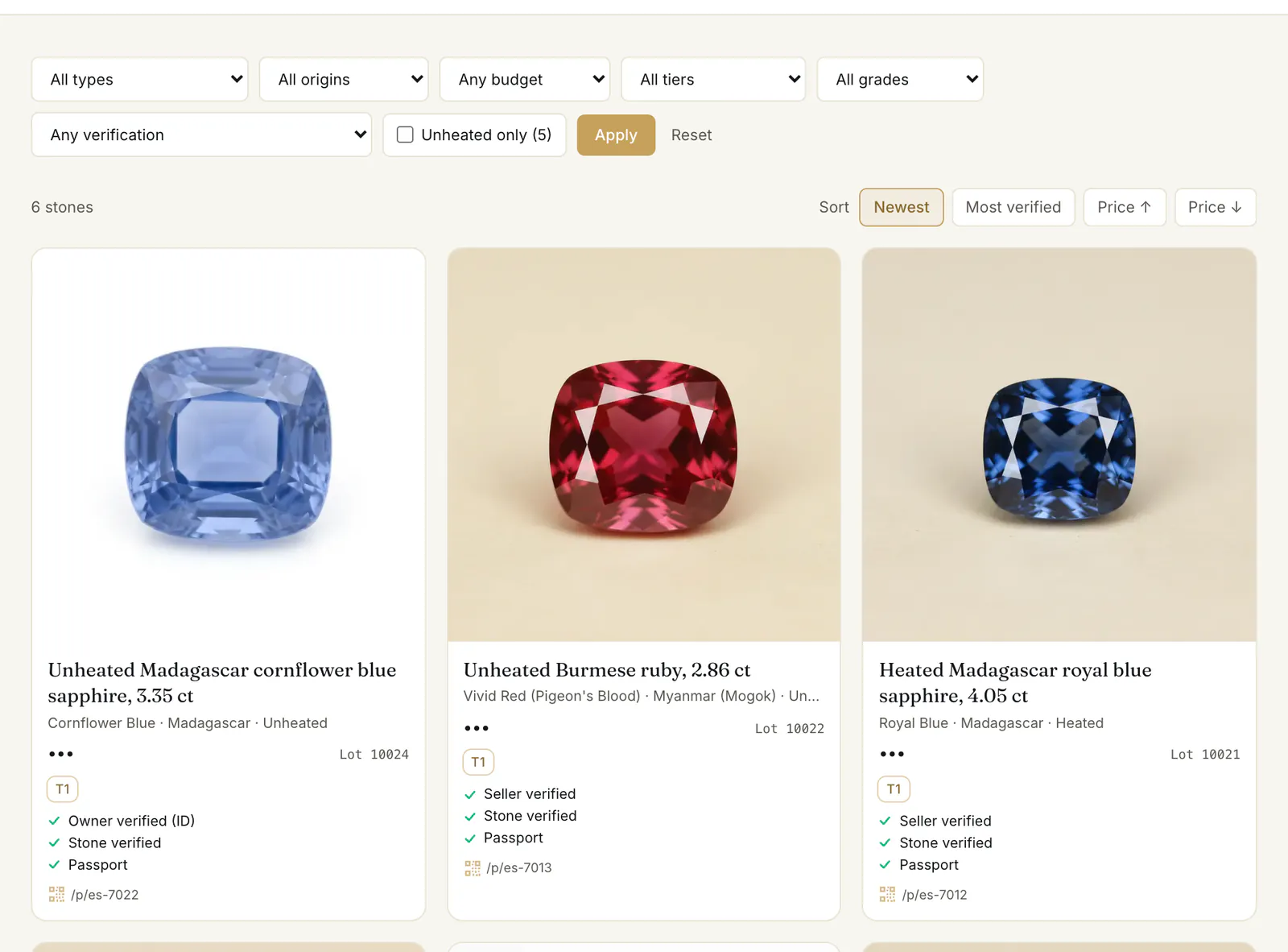
Every card in the shop ③, and the top of every lot page, carries up to three short lines, always in the same order. A tick (✓) is something that is true today. A ring (○) is the seller's word, or something you can add when you buy.
- 1.The seller. “Seller verified” — a business whose company registration and director our desk has checked. “Owner verified (ID)” — a private owner whose identity has been checked.
- 2.The stone. One of:
- “Stone verified” — checked by hand: someone on our side held the stone and matched it to its report.
- “Report checked with the lab” — the report was confirmed against the laboratory's own records. The stone itself has not been seen.
- “Lab certificate shown” — the listing shows a lab certificate. That is the seller's paper, not our check.
- “Stone as declared by the seller” — nothing about the stone has been checked yet.
- 3.What it has, or what you can add. “In custody” or “Passport” when the stone has them; otherwise “Custody available”, “Passport available” or “Independent lab check available”.
The stamp: four levels
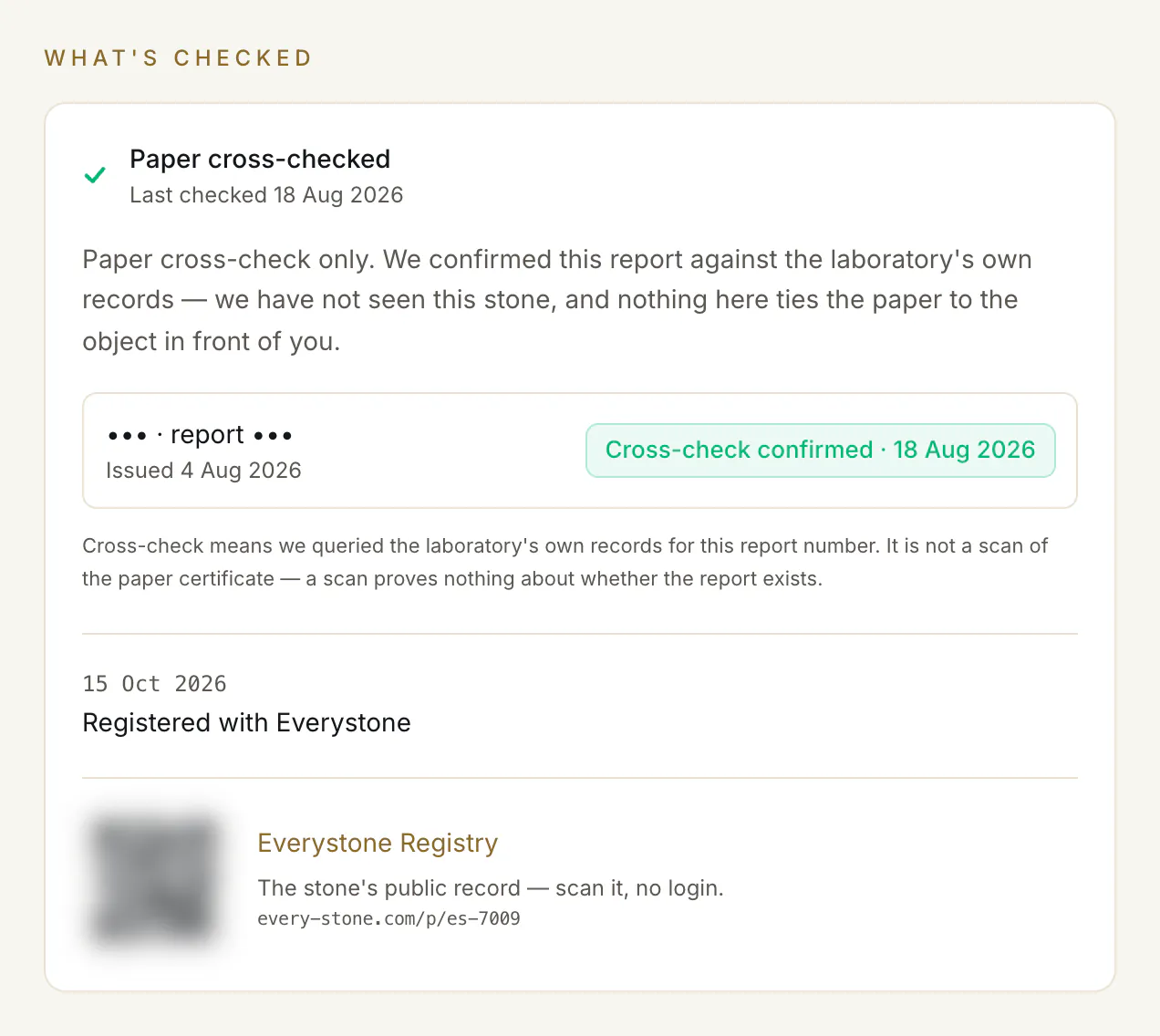
On a lot page, the section “What's checked” shows a stamp and one plain sentence about what it is worth.
| Stamp | Words | What it means |
|---|---|---|
| ○ | “Seller-declared” | Only the seller is verified. The facts and photos are the seller's own. |
| ✔ | “Paper cross-checked” | The report was confirmed with the lab that issued it; nobody has seen the stone. |
| ✔✔ | “Verified: paper = this stone” | A verifier held this stone and measured it against the report. |
| ✔✔✔ | “In custody — passport reflects title” | The stone is in a vault; while it stays there, its passport matches this stone and this owner. |
Each report on the lot is listed with its state ②: “Cross-check confirmed”, “Cross-check pending” or “Not cross-checked”. A cross-check means the laboratory's own records were asked about the report number — not that someone looked at a scan of the paper.
You will also meet three words for a lot as a whole: “Full verification” (everything that applies is checked — for a loose stone, a verified seller and the stone checked by hand), “Partly verified” (something beyond the seller is checked) and “Seller-declared” (only the seller is).
The four levels of a check
- Seller-declared
Only the seller is verified. The facts and photos are the seller's own.
- Card
- ○ Stone as declared by the seller
- The lot
- Seller-declared
- Public page
- none
- Paper cross-checked
The report was confirmed with the lab that issued it. Nobody on our side has seen the stone.
- Card
- ✓ Report checked with the lab
- The lot
- Partly verified
- Public page
- yes, with a QR code
- Verified: paper = this stone
A verifier held this stone and measured it against its report.
- Card
- ✓ Stone verified · ✓ Passport
- The lot
- Full verification
- Public page
- yes, with a QR code
- In custody — passport reflects title
The stone is in a vault. While it stays there, its passport matches this stone and this owner.
- Card
- ✓ Stone verified · ✓ In custody
- The lot
- Full verification
- Public page
- yes, with a QR code
The passport and its public page
From one tick (✔) up, a stone has a public record anyone can open without an account — under $10,000 it is called the Everystone Registry record, from $10,000 the Everystone Passport. On the lot page it sits under “What's checked”, with a QR code ③: “The stone's public record — scan it, no login.”
The public page shows the stone's identity, its lab reports, origin and treatment, its provenance and its custody status. It says plainly what it leaves out — the owner, valuations and documents.
A Seller-declared stone has no public page and no QR code. That is deliberate: a passport for a stone nobody has checked would claim what nobody knows.
Price bands: T0, T1, T2
A small badge next to the price ④ marks the band. Under $10,000 is T0 (Registry), from $10,000 to $30,000 is T1 (Passport) and from $30,000 is T2 (Custody). The band decides what you can add at checkout — see Lab check, Passport or custody. The badge alone does not mean the stone already has a Passport or is in custody; the three lines above tell you that.
Price bands and what you can add
- T0RegistryUnder $10,000
You can add
- Independent lab check$51 to $166, the lab's own fee
- orEverystone Passport$750
- T1Passport$10,000 to under $30,000
You can add
- Everystone Passport$750
- T2CustodyFrom $30,000
You can add
- Everystone Passport$750
- orPassport and custody$1,500, then 3.5% of the stone's value a year
Filter and sort by what is checked
In the shop, the verification filter ① has “Fully verified only”, “Anything checked beyond the seller” and “In custody only”. The sort “Most verified” ② puts stones in custody first, then stones checked by hand, then stones whose report was checked, then the rest.
Common problems
“Lab certificate shown” — so the stone is checked?
No. The listing shows a certificate, which is the seller's paper. To have the stone itself checked before it reaches you, add the independent lab check or a Passport at checkout.
A lot has no passport page
It is Seller-declared. Its page says what is and is not checked, and you can still add a check when you buy.
A lot says “Reserved”
“Reserved — another buyer is completing the purchase of this stone.” If their order ends unpaid, the stone comes back to the shop.
Read next
- Next in Getting startedThe identity check: when it is needed and how to pass itA short check of who you are: name, country and a photo of your ID. When a buyer or a private seller needs it, how to send it, and what if it is returned.
- RelatedHow to buy a stone: from the lot page to your orderOpen a lot, press Buy with protected payment, choose what to add and how the stone reaches you, then confirm. What each choice means and what happens next.
- RelatedAdding a lab check, a Passport or custody to your purchaseWhat you can add to a stone at checkout, what it costs by price band, why it is billed once the stone is confirmed, and what "not refundable" means.
Something here doesn't match what you see? Tell us — write to the desk.